
If you are looking for a puppy training school Gold Coast families can rely on, starting your puppy’s training early can help build good habits from the beginning. The early months are an important time for learning confidence, bite inhibition, toilet habits, lead manners, recall, calm behaviour and appropriate socialisation. These skills can make everyday experiences such as walks, visiting cafés, meeting people and encountering other dogs easier to manage.
Choosing the right puppy training school in Gold Coast also involves more than finding a weekly class. You may want to consider the puppy’s age, vaccination requirements, class size, training methods, course structure and the type of support provided to owners. It is also useful to understand the difference between puppy classes, private puppy training and Puppy Bootcamp, as each option provides a different level of structure and individual attention.
Quick Answer
A puppy training school on the Gold Coast typically provides structured group classes for young puppies, often covering puppy socialisation, basic obedience, recall, loose-lead walking, bite inhibition, settling and everyday manners. Courses commonly run over several weekly sessions, with requirements such as age limits and appropriate vaccinations varying between providers.
The cost of puppy training on the Gold Coast also varies depending on the course length, class size, training format and services included. Group puppy classes are generally more affordable than private training or residential-style programmes, while Puppy Bootcamp and other intensive options provide a more structured approach.
At Master Of Puppies, we help Gold Coast puppy owners build practical foundations through structured training focused on confidence, obedience, communication and everyday behaviour. This guide explains what to look for when choosing a puppy training school, including the right age to start, socialisation, vaccination considerations, course costs, training options and local responsibilities for dog owners.
What Is a Puppy Training School?
A puppy training school (also called puppy school, puppy preschool or puppy kindy) is a short, structured course that educates both the puppy and the owner during the critical socialisation window.
It is not obedience competition training. A good puppy school focuses on three outcomes:
- Prevention — stopping biting, jumping, chewing, toilet accidents and lead pulling before they become habits.
- Socialisation and neutrality — teaching your puppy to stay calm around dogs, people, surfaces, sounds and traffic instead of becoming over-excited, fearful or reactive.
- Owner skills — timing, marker words, reward delivery, structure, boundaries and household management.
Puppy School vs Puppy Kindy vs Puppy Preschool — Is There a Difference?
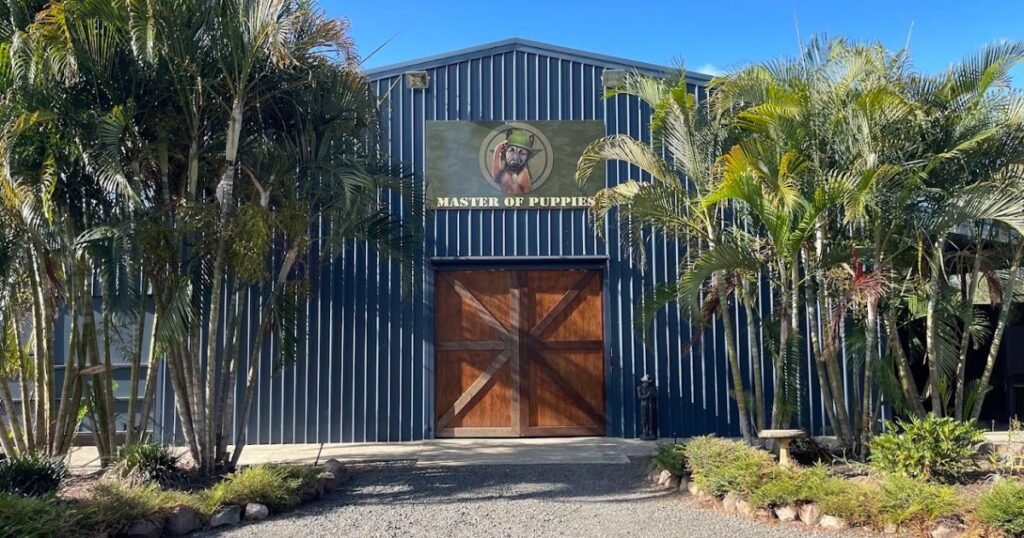
Practically, no. On the Gold Coast these terms are used interchangeably. “Puppy kindy” and “puppy preschool” are often used by vet clinics and pet retailers, while “puppy school” and “puppy bootcamp” are more common with dedicated dog training facilities. What actually matters is the curriculum, trainer qualifications, class size and whether the venue is purpose-built for training.
When Should Your Puppy Start Puppy School on the Gold Coast?
The ideal window to start puppy school is between 8 and 16 weeks of age. This is the primary socialisation period, when a puppy’s brain is most receptive to new experiences and least likely to form lasting fear responses. We break the reasoning down further in our guide to the best age to start puppy training.
H3: The Puppy Development Timeline
| Age | Stage | What Matters Most |
| 3–8 weeks | With breeder / litter | Litter manners, early handling, weaning |
| 8–12 weeks | Prime socialisation | New surfaces, sounds, people, gentle exposure, toilet training, crate training |
| 12–16 weeks | Late socialisation | Structured classes, neutrality around dogs, lead foundations, recall |
| 16–24 weeks | Juvenile | Impulse control, teething management, distraction proofing |
| 6–12 months | Adolescence | Boundary testing, recall breakdown, reactivity risk — needs continued training |
What If My Puppy Is Already Older Than 20 Weeks?
You have not missed the boat — you just need a different program. Puppies over roughly 5–6 months move into our Doggy Bootcamp for dogs 6 months and over, because their needs shift from socialisation to impulse control and boundary setting.
Adolescence (6–18 months) is when most Gold Coast owners suddenly report “he used to listen, now he ignores me.” That is normal, it is predictable, and it is trainable.
Vaccination Requirements Before Puppy School in Queensland
This is the question most Gold Coast puppy school pages skip — and it is the one that stops owners from booking.
H3: C3 vs C5 — What’s the Difference?
- C3 (core): protects against parvovirus, distemper and infectious hepatitis.
- C5: C3 plus kennel cough protection (Bordetella bronchiseptica and parainfluenza).
What Most Gold Coast Puppy Schools Require
| Program type | Typical minimum requirement |
| Indoor / sterilised-venue puppy school | First vaccination (C3), given ~10 days before class |
| Outdoor or mixed-age classes | Current C5 |
| Doggy daycare and boarding | Current C5, plus flea and worm treatment |
| Board & train | Current C5 and full puppy course completed |
Important: requirements vary between providers, and your vet’s advice for your individual puppy always takes priority. Puppies typically receive 2–3 vaccinations between 6 and 16 weeks, and a full puppy vaccination course in Australia generally costs somewhere in the $200–$450 range depending on the clinic and whether health checks are bundled.
Should I Wait Until All Vaccinations Are Done?
Waiting until 16–18 weeks means missing the socialisation window entirely — and behavioural problems, not infectious disease, are the leading reason young dogs are surrendered in Australia. The accepted balance is to attend a clean, sterilised, controlled training venue with vaccinated puppies rather than a public dog park or beach. Our guide on how to socialise a puppy safely explains exactly how to do this before full vaccination. Always confirm the plan with your vet.
What You’ll Learn at a Gold Coast Puppy Training School
A quality 4-week puppy foundations course should have a written, week-by-week curriculum. Here is what a strong program looks like — and it is the structure we use in our Puppy Bootcamp for 10–20 week olds.
1 week — Puppy Ownership Foundations
- Puppy development stages and realistic expectations
- Structure, routine and household boundaries
- Correct equipment selection and use (collar, lead, harness, crate)
- Nutrition, feeding schedules and toilet training
- Crate training and habit building
- Preventing the most common behaviour problems before they start
2 Week — Place / Bed Command & Environmental Confidence
- Teaching a reliable “place” or “bed” command
- Building duration, stillness and genuine calmness (not just compliance)
- Exposure to new surfaces, sounds, movement and objects
- Structured puppy obstacle work for coordination and resilience
Week 3 — Loose Lead Walking & Sit
- “With me” loose-lead walking foundations
- Correct handler position and engagement
- Preventing pulling and disengagement before adolescence
- Sit foundations, marker timing and reward placement
Week 4 — Recall & Revision
- Recall foundations and building drive back to the handler
- Reliable recall mechanics and reward delivery
- Full revision, troubleshooting and real-life application
The Skill Most Schools Under-Teach: Social Neutrality
Plenty of puppy classes are 45 minutes of off-lead puppy wrestling. That is fun, but it teaches a puppy that every dog it sees is a play opportunity — which becomes lead frustration, barking and lunging at 9 months old.
Social neutrality — being calm and focused around other dogs and people rather than fixated on them — is the single most valuable thing a Gold Coast puppy can learn before adolescence.
Puppy School vs Private Training vs Board & Train — Which Do You Need?
| Option | Best for | Format | Typical duration |
| Group puppy school | 10–20 week puppies, first-time owners | Small group, weekly | 4–5 weeks |
| Private training | Nervous puppies, specific problems, busy schedules | One-on-one | Per session or package |
| Doggy daycare | Energy, fitness, structured socialisation | Day program | Ongoing |
| Board & train | Fast results, owners short on time | Live-in with trainers | 1–4 weeks |
| Adolescent bootcamp | Boundary testing, recall failure, pulling | Small group | Multi-week |
A Simple Decision Rule
- Puppy under 20 weeks, no major issues → group puppy school
- Puppy is fearful, reactive, or your schedule is unpredictable → private dog training first, then group
- Dog is over 6 months and problems are already established → a board & train program delivers the fastest turnaround
How Much Does a Puppy Training School Cost on the Gold Coast?
Dog training on the Gold Coast generally ranges from around $120 to $3,500 depending on the format, your dog’s age and behaviour, and program length. We break every format down in our full guide to how much dog training costs in Gold Coast.
| Service | Typical Gold Coast price range |
| Group puppy school (4–5 weeks) | $150 – $450 |
| Single private training session | $120 – $250 |
| Private training package (3–5 sessions) | $450 – $1,200 |
| Doggy daycare (per day) | $45 – $90 |
| Board & train (1–4 weeks) | $1,500 – $3,500+ |
Prices are indicative market ranges for 2026 and vary by provider — see our current rates for exact pricing.
What Actually Affects the Price
- Class size — a 6-puppy cap costs more to run than a 15-puppy class, and delivers far more individual attention.
- Trainer experience — working-dog and behaviour-qualified trainers command higher rates.
- Facility — a purpose-built training centre with obstacle equipment costs more than a park meet-up.
- Included support — some schools include between-class support, written notes and follow-up; others do not.
Is Puppy School Worth the Money?
Compare it to the alternative. A single behaviour consult for an adolescent dog with lead reactivity typically costs more than an entire puppy foundations course. Add replaced furniture, chewed skirting boards, fence repairs and the stress of a dog you cannot walk comfortably, and prevention is dramatically cheaper than rehabilitation.
How to Choose the Best Puppy Training School on the Gold Coast

Ask these seven questions before you pay a deposit:
- What is the maximum class size? Six puppies or fewer means real coaching. Fifteen means crowd control.
- Is there a written week-by-week curriculum? If they cannot show you one, there probably isn’t one.
- What are the trainers’ actual qualifications and background? Ask specifically — not just “years of experience.”
- What happens after the course? A good school has a clear pathway into adolescent training.
- Is the venue purpose-built and cleaned between classes? Critical for partially vaccinated puppies.
- Do they train the owner, or just the puppy? You are the one who lives with the dog.
- Can you observe a class before enrolling? Confident schools say yes.
Red Flags to Walk Away From
- Guarantees of a “fully trained dog in one week”
- No vaccination policy at all
- All free play, no structured teaching
- Refusal to explain their methods or equipment
- No local reviews, or reviews that only mention the puppies being cute
Positive Reinforcement, Balanced Training — What’s the Difference?
Positive reinforcement training builds behaviour by rewarding what you want — food, play, praise and access to things the puppy values. It is the backbone of every good puppy program and should make up the overwhelming majority of what happens in a puppy class.
Balanced training adds clearly communicated boundaries and consequences once a dog fully understands a behaviour, typically later in training and mostly with adolescent or adult dogs.
For a 10–20 week old puppy, the answer is simple: rewards, clear markers, structure and management — not corrections. Any Gold Coast puppy school using aversive tools on a young puppy should be questioned closely. What you want is a trainer who can explain why they use what they use, and adjust it to your individual puppy.
Gold Coast Council Rules Every New Puppy Owner Must Know
Training is only half of responsible ownership. Under City of Gold Coast requirements and Queensland’s Animal Management (Cats and Dogs) Act:
- Microchipping is required before your puppy reaches 12 weeks of age.
- Council registration is required from 12 weeks of age, or within 14 days of moving into the city with a dog.
- Desexed dogs pay a substantially lower registration fee than undesexed dogs, and concessions may apply.
- Excess animal permits are needed to keep more than the standard number of dogs on a property.
- Your dog must be effectively controlled in public — on lead outside designated off-leash areas.
Check the current fees and forms directly on the City of Gold Coast website, as they are reviewed annually.
Off-Leash Areas Aren’t Puppy Training Grounds
Gold Coast has excellent off-leash parks and dog beaches — but they are a reward for a trained recall, not a place to build one. Take an under-socialised or partially vaccinated puppy to a busy off-leash beach and you risk both illness and a genuinely frightening experience that can set training back months. The RSPCA also recommends gradually introducing puppies to new environments and experiences in a safe, controlled way during their early development.
Common Puppy Problems on the Gold Coast (And How Puppy School Fixes Them)
Puppy Biting and Nipping
Normal, developmental, and fixable. Puppy school teaches bite inhibition, redirection onto appropriate outlets, and — critically — how to stop accidentally rewarding the behaviour with attention.
Destructive Chewing
Teething is unavoidable; destroyed skirting boards are not. Management, appropriate chew outlets and consistent supervision solve most cases. If your puppy is chewing furniture, shoes or household items, read our detailed guide on puppy chewing in Gold Coast for practical training tips and prevention strategies.
Toilet Training Accidents
Almost always a management and schedule problem rather than a puppy problem. Structured feeding, crate use, supervision windows and consistent timing resolve most cases within weeks.
Jumping Up on Visitors
Prevented by teaching an incompatible behaviour (place or sit) before the doorbell becomes an excitement trigger.
Pulling on the Lead
The Gold Coast humidity makes a pulling dog genuinely unpleasant to walk. Loose-lead foundations laid at 12 weeks are ten times easier than retraining a 30kg adolescent. If your puppy is already pulling on the lead, read our guide on how to stop a dog pulling on the lead for practical techniques that build calm, enjoyable walks.
Separation Anxiety and Crate Distress
Built by degrees through crate conditioning, duration work and independence exercises — ideally before it becomes distress. Read our complete guide to puppy crate training in Gold Coast for a step-by-step approach.
Excessive Barking
Address the driver, not the noise. Boredom barking, alert barking, frustration barking and attention-seeking barking each need a different response.
Recall That Falls Apart at 8 Months
Adolescent recall breakdown is predictable. Puppies that learn engagement and a genuine drive back to the handler — rather than a command they merely tolerate — hold their recall through adolescence.
What to Bring to Your First Puppy Class
- Vaccination certificate
- Flat collar and a 1.2–1.8m lead (no retractable leads)
- High-value soft treats, cut small
- A mat or towel for settle work
- Water and a poo bag supply
- Every family member who will handle the puppy, if the school allows it
- A hungry puppy — skip the meal right before class
Puppy Training Across the Gold Coast
Master Of Puppies serves puppy owners from Molendinar, Southport, Arundel, Paradise Point, Ormeau, Robina, Varsity Lakes, Nerang, Coomera, Helensvale, Burleigh Heads, Surfers Paradise, Broadbeach, Mermaid Waters, Palm Beach, Hope Island and Upper Coomera, plus a second facility at Gleneagle for enrichment-based daycare and boarding on acreage.
Why Master Of Puppies Is a Different Kind of Puppy Training School
- Maximum 6 puppies per class — genuine one-on-one guidance inside a group setting
- Veteran-led team — every trainer has been trained by, or is, a former Australian Special Forces military working dog handler
- Purpose-built Gold Coast HQ with a structured puppy obstacle course for confidence and environmental development
- Social neutrality focus — not just free play
- A full pathway — puppy bootcamp → adolescent bootcamp → private training and board & train
- 300+ five-star Google reviews across two locations
- Two sites — Molendinar (Gold Coast) and Gleneagle (Farm)
Frequently Asked Questions About Puppy Training School on the Gold Coast
What age can a puppy start puppy school on the Gold Coast?
Many puppy schools accept puppies from around 8 weeks of age, although age limits vary between providers. Starting training during the early developmental period can help puppies learn appropriate socialisation, basic obedience and everyday manners. At Master Of Puppies, the Puppy Bootcamp programme is designed for puppies aged 10 to 20 weeks.
How long does puppy school take?
Most puppy foundations courses run for several weeks, with one structured class each week. A typical course may run for around 4 weeks, although session length and course structure vary between training providers. At Master Of Puppies, puppy training focuses on practical skills that owners can continue practising between sessions.
What vaccinations does my puppy need before puppy school?
Vaccination requirements vary between puppy schools, so check the provider’s current requirements before booking. Many puppy classes require puppies to have received age-appropriate vaccinations before attending group sessions. Your veterinarian can also advise when your puppy is ready to participate safely in different environments.
How much does puppy school cost on the Gold Coast?
The cost of puppy training on the Gold Coast varies according to the provider, course length, class size and training format. Group puppy courses are generally less expensive than one-on-one private training, while intensive options such as Puppy Bootcamp or Board & Train can cost more because they involve additional training and support.
When comparing prices, look at what is included rather than comparing the course fee alone. Consider the number of sessions, class size, trainer experience, owner education and whether you receive resources or ongoing support.
Is puppy school actually worth it?
Puppy school can be a useful starting point for owners who want guidance with early socialisation, basic obedience and everyday puppy behaviour. It also gives owners an opportunity to practise handling and communication in a structured environment.
The value depends on the individual puppy and the quality of the programme. Puppies with more complex behavioural concerns may benefit from additional private training alongside or instead of a group puppy class.
Can I bring my kids to puppy class?
Some puppy schools allow children to attend, while others have limits on the number of family members or set specific age requirements. Children can benefit from learning how to interact appropriately with a puppy, but the training environment also needs to remain calm and manageable.
Always check the provider’s attendance policy before bringing children to a puppy class.
My puppy is shy and nervous. Is a group class the right choice?
Not necessarily. A shy or nervous puppy may need a more gradual introduction to new people, dogs, sounds and environments. Depending on the puppy’s behaviour, a private assessment or smaller training environment may be more appropriate.
A qualified trainer can assess the puppy’s responses and help determine whether group puppy training, private sessions or a combination of both is suitable.
What’s the difference between puppy school and dog obedience training?
Puppy school generally focuses on early socialisation, confidence, owner education, basic obedience and developing appropriate everyday habits. Dog obedience training can provide a more advanced focus on reliable responses, impulse control, loose-lead walking, recall and obedience around distractions.
The two approaches can work together. Puppy training provides an early foundation, while ongoing obedience training helps strengthen those skills as the dog matures.
Do I need to register my puppy with the City of Gold Coast?
Dog registration requirements apply in Queensland, but the exact requirements, deadlines and fees can change. Owners should check the City of Gold Coast and Queensland Government requirements for current information about microchipping, registration, desexing and keeping a dog legally within the local area.
Registration requirements can also depend on the dog’s age and circumstances, so confirm the current rules before relying on information from a training provider.
My puppy is already 6 months old — have I missed the window?
No. A six-month-old puppy can still learn new behaviours and develop better training habits. While early socialisation and puppy training can provide valuable foundations, training does not stop when a puppy reaches a particular age.
Older puppies may benefit from training that focuses more heavily on impulse control, recall, loose-lead walking, focus, boundaries and obedience around distractions. The right programme depends on the dog’s current behaviour and training history.
Do you offer puppy training near Southport, Robina or Helensvale?
Master Of Puppies provides puppy training from its Gold Coast HQ in Molendinar, making it accessible to owners travelling from different parts of the Gold Coast. Training is also available through the Gleneagle farm facility for suitable programmes.
Check the current course details and location requirements before booking, as different training programmes may operate from different facilities.
What if my puppy doesn’t get along with other puppies in the class?
Puppies do not need to interact directly with every other puppy to benefit from a group training environment. Good puppy socialisation is about learning to remain calm and comfortable around different people, dogs, sounds and environments — not simply encouraging puppies to play together.
A trainer can use appropriate distance, positioning and controlled exposure to help puppies learn without forcing interaction. If a puppy is becoming overwhelmed, the trainer should adjust the environment and training approach to suit that puppy’s needs.
Conclusion
Choosing a puppy training school Gold Coast owners can trust involves more than simply finding the closest puppy class. Look at the class size, course structure, training methods, trainer experience and the level of guidance provided to owners.
A good puppy training programme should help you understand how your puppy learns while building practical skills such as socialisation, recall, basic obedience, loose-lead walking, settling and appropriate everyday behaviour. Starting early can give you a useful foundation, but puppies and young dogs can continue learning well beyond their first few months.
If your puppy is between 10 and 20 weeks old, Master Of Puppies’ structured Puppy Bootcamp provides a focused training environment for developing confidence, obedience and practical everyday skills.
Ready to Enrol? Book Your Puppy’s Spot Today
Master Of Puppies runs small-group Puppy Bootcamp classes at its purpose-built Molendinar HQ, with classes capped at six puppies. The programme is designed to give puppies structured training while helping owners develop clearer communication and practical handling skills.
📞 Call: 0478 111 667
✉️ Email: info@masterofpuppies.com.au
📍 Gold Coast HQ: 60 Export Drive, Molendinar QLD 4214
🚜 Farm: 118–126 Veresdale Scrub Rd, Gleneagle QLD 4285
BOOK YOUR PUPPY BOOTCAMP ONLINE
If you’re looking for structured puppy training on the Gold Coast, review the programme details and choose the training option that best suits your puppy’s age, behaviour and individual needs.